Spatial relations activities for kids, with free PDFs
Where things are, and which way they face. Telling b from d, or putting the toy under the chair.
What is spatial relations?
Spatial relations (also called position in space) is understanding where things are compared with each other and with yourself: above, below, in front, behind, left, right, and which way something is turned.
Why it matters
It is behind telling b from d and p from q (the same shape, facing another way), lining up numbers in columns for math, leaving spaces between words, reading a map, and moving around without bumping into things.
Signs a child finds spatial relations hard
- Often reverses letters or numbers (b and d, 2 and 5) as they move through the first school years
- Has trouble with position words: under, behind, next to
- Writes words without spaces, or letters that wander off the line
- Finds it hard to copy a block tower or a simple design
- Often bumps into things or misjudges distances
These are everyday observations, not a checklist and not a diagnosis: every child develops at their own pace, and many children show a few of these now and then. If something worries you, talk to your child's teacher or doctor. Eyesight is checked by an eye doctor; visual perception can be assessed by an occupational therapist.
6 spatial relations activities for home and the classroom
-
Teddy positions At home
Ask your child to put a teddy under the chair, behind the door, next to the lamp, on top of the box. Then let them give you the orders.
-
Copy my tower At home or in class
Build a small tower or pattern of blocks and ask your child to copy it. Then copy it from a photo, which is harder.
-
Which way? At home or in class
Turn toy cars or arrows cut from paper in different directions and ask your child to make theirs point the same way as yours.
-
Treasure map At home
Draw a simple map of a room with an X where a treat is hidden. Reading a map means turning what you see on paper into real places.
-
Grid copy In class
Color a few squares on a 3 × 3 grid and ask children to color the same squares on an empty grid. Grow to 4 × 4 and 5 × 5.
-
Printable Which way? At home or in class
The free sheets below show rows of the same Oopsie: one is turned another way. In the hard one, the whole row leans and one leans the other way.
Free spatial relations printables
Made with the Oopsies from our game: one page to print, the answer key on page 2. Free for home, classroom and therapy use.
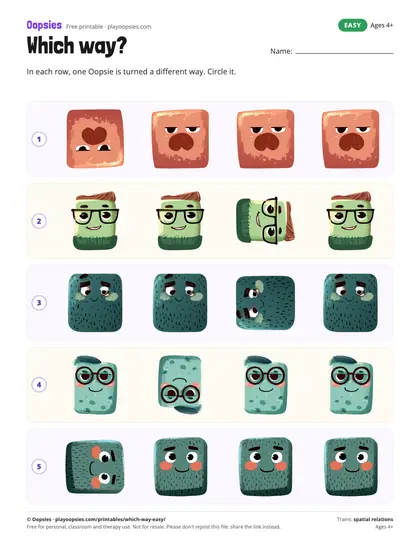 Which way? One Oopsie per row is upside down or on its side.
Download PDF (123 KB)
Which way? One Oopsie per row is upside down or on its side.
Download PDF (123 KB) 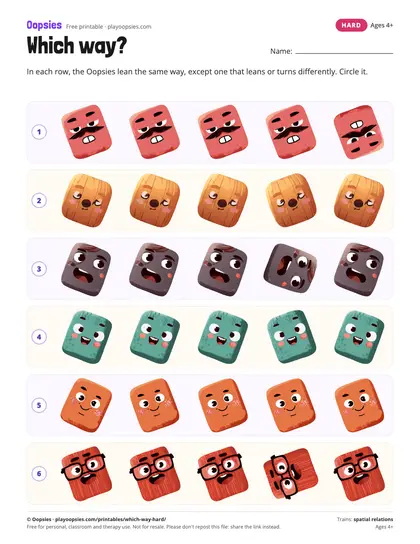 Which way? Rows lean one way; one Oopsie leans the other way.
Download PDF (125 KB)
Which way? Rows lean one way; one Oopsie leans the other way.
Download PDF (125 KB) Oopsies worlds that use spatial relations
Oopsies is a seek-and-find game, and each world adds a twist. These are the ones where spatial relations does most of the work:
🐘 Tiny Titans
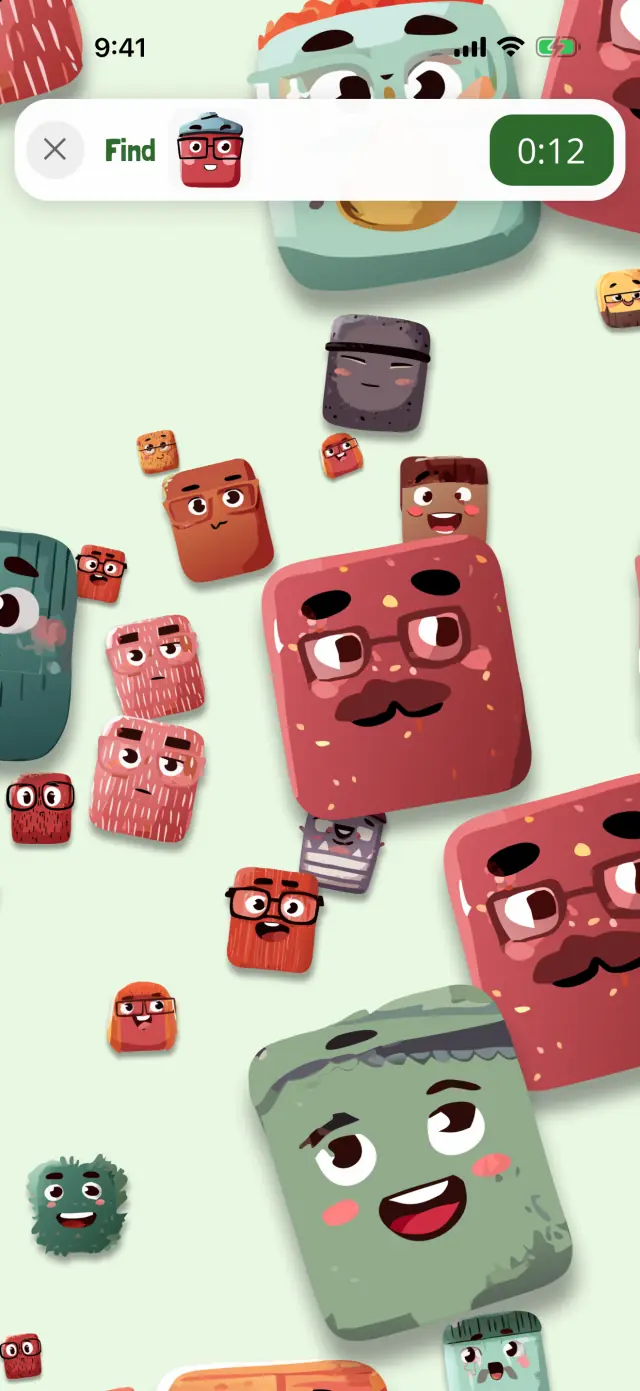
Oopsies of very different sizes spread over a field bigger than the screen. Children drag to look around and pinch to zoom, tiny Oopsies hide under giants, and later levels turn the Oopsies in every direction.
More about the Tiny Titans worldRelated visual skills
Questions about spatial relations
Is it normal for children to reverse letters?
Yes, many young children reverse letters like b and d while they learn to read and write; it is a common part of learning. If reversals stay frequent as your child moves through school, mention it to their teacher.
What are spatial relations activities?
Anything that asks a child to place, compare or copy positions and directions: following position words, copying a block tower, reading a simple map, or finding the picture that faces another way.
Is spatial relations the same as spatial awareness?
They overlap. Spatial awareness usually means your own body in space (not bumping into things); spatial relations also covers how objects are placed and turned compared with each other, like letters on a page.
Last updated: October 16, 2026