Visual tracking activities for kids, with free PDFs
Following a moving thing, or a line, with the eyes. Following a ball through the air, or a line of text.
What is visual tracking?
Visual tracking is the ability to follow something with the eyes, smoothly and without losing it: a ball flying through the air, a bubble floating away, or a line of text across the page.
Why it matters
Reading is tracking: the eyes move along a line, then jump back to the start of the next one. Tracking also matters for copying from the board, for ball games, and for keeping an eye on the teacher as they move around the room.
Signs a child finds visual tracking hard
- Loses their place when reading, skips lines or reads the same one twice
- Moves their whole head instead of their eyes to follow something
- Still needs a finger to keep their place long after classmates have stopped
- Finds catching or hitting a ball hard
- Says that reading is tiring (worth an eye check too, to rule out eyesight)
These are everyday observations, not a checklist and not a diagnosis: every child develops at their own pace, and many children show a few of these now and then. If something worries you, talk to your child's teacher or doctor. Eyesight is checked by an eye doctor; visual perception can be assessed by an occupational therapist.
6 visual tracking activities for home and the classroom
-
Bubble watch At home
Blow bubbles and ask your child to follow one bubble with their eyes, head still, until it pops. Then pick another.
-
Flashlight tag At home
In a dim room, move a flashlight beam slowly around the wall. Your child follows it with their own flashlight, trying to keep the two beams together.
-
Balloon keep-up At home or in class
Keep a balloon in the air as long as possible. It's slow enough for young eyes to follow, and fun.
-
Tangled strings At home or in class
Lay a few pieces of yarn across a table, crossing each other, with a toy at each end. Which toy is each string tied to? Eyes first, then fingers to check.
-
Wide mazes In class
Simple mazes with wide paths: trace with a finger first, then with a pencil.
-
Printable follow the strings At home or in class
The free sheets below have tangled strings from each Oopsie to a bubble. The hard one has five strings and many crossings.
Free visual tracking printables
Made with the Oopsies from our game: one page to print, the answer key on page 2. Free for home, classroom and therapy use.
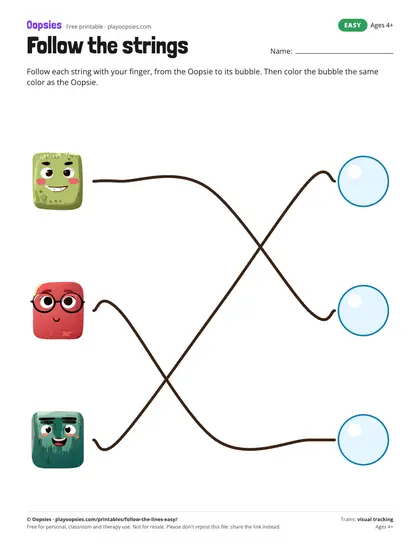 Follow the strings 3 tangled strings from the Oopsies to their bubbles.
Download PDF (95 KB)
Follow the strings 3 tangled strings from the Oopsies to their bubbles.
Download PDF (95 KB) 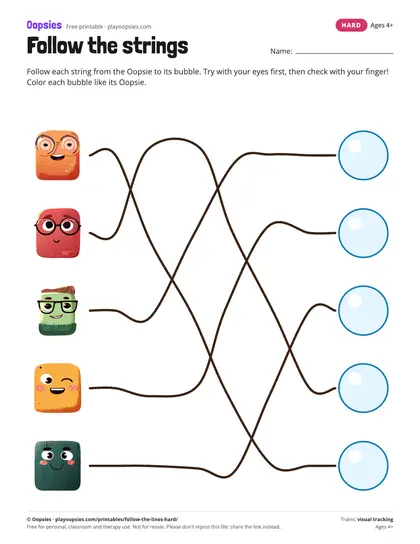 Follow the strings 5 strings with many crossings.
Download PDF (126 KB)
Follow the strings 5 strings with many crossings.
Download PDF (126 KB) Oopsies worlds that use visual tracking
Oopsies is a seek-and-find game, and each world adds a twist. These are the ones where visual tracking does most of the work:
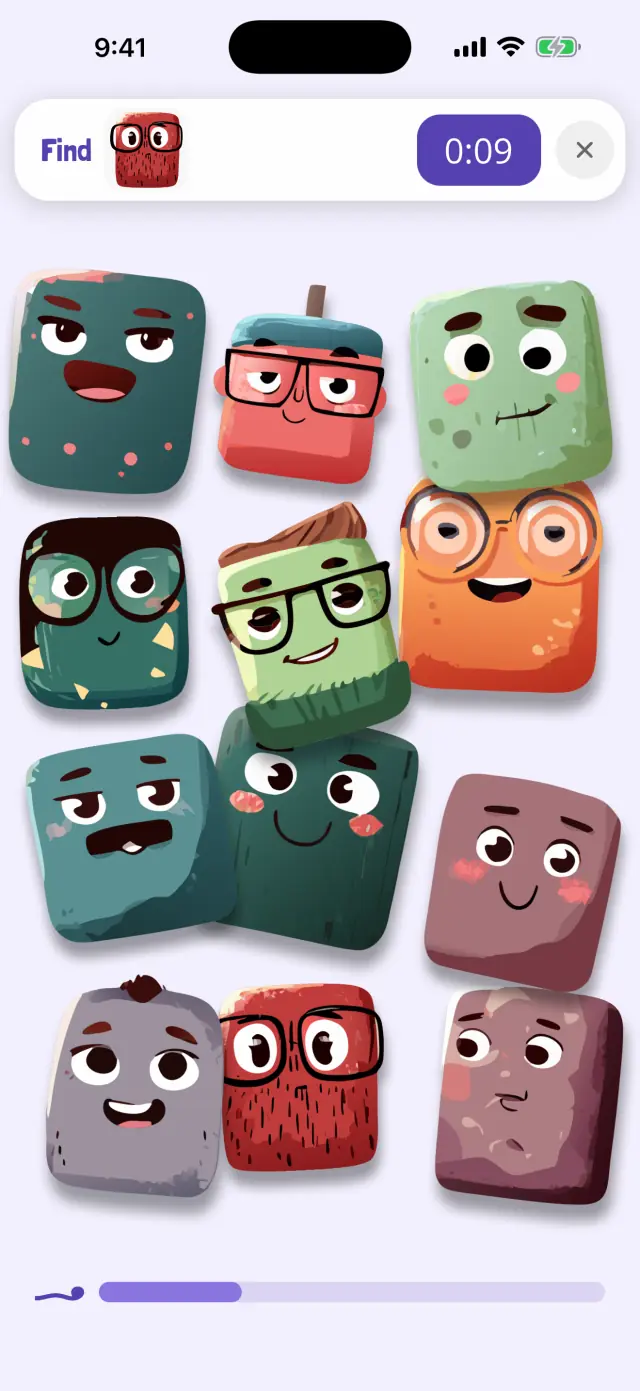
🌬️ Whoosh!
Every so often, a gust of wind sends the Oopsies flying and mixes them up. Children keep their eyes on the Oopsie they are after as it flies, or find it again afterwards. Later gusts come more often and spin the Oopsies around.
More about the Whoosh! world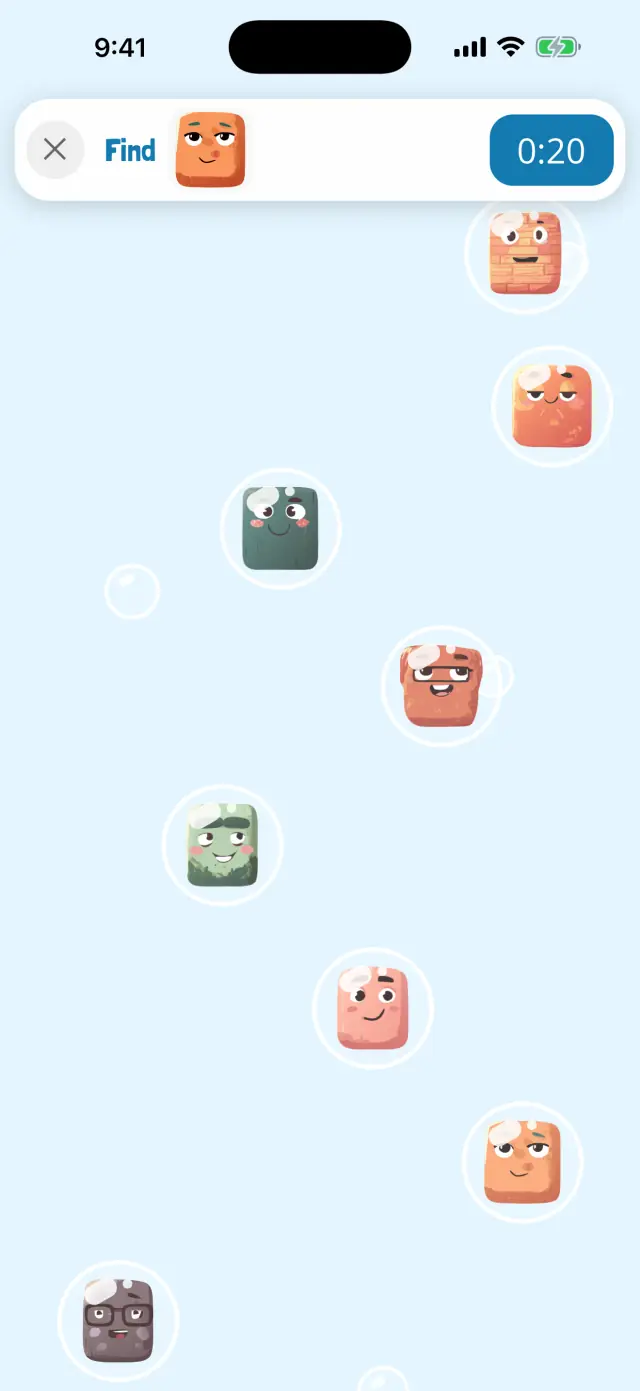
🫧 Bubble Pop
The Oopsies rise in bubbles from the bottom of the screen, wobbling as they go. Children follow the right bubble and pop it; if it floats away, it comes back a little later.
More about the Bubble Pop worldRelated visual skills
Questions about visual tracking
What is visual tracking in simple words?
Following something with your eyes without losing it: a moving ball, a bubble, or the line you are reading.
What is the difference between visual tracking and visual scanning?
Tracking follows one thing (something moving, or a line). Scanning searches a whole still scene, in order. Reading needs both.
Should my child use a finger when reading?
Using a finger or a bookmark under the line is a common, helpful habit for beginning readers. Most children drop it on their own as reading becomes easier.
Last updated: October 16, 2026