Form constancy activities, with free worksheets
Recognizing a shape at any size, color or angle. Knowing an 'a' is an 'a' in any font.
What is form constancy?
Form constancy is the ability to recognize a shape or an object even when it changes size, color, position or direction. A triangle is still a triangle when it's huge, tiny, upside down or red, and a cup is still a cup seen from above.
Why it matters
Children meet letters in many fonts, sizes and handwritings, and need to know that an 'a' is an 'a' in all of them. The same goes for numbers in a book and on the board, and for recognizing a familiar object from a new angle.
It also helps when copying from the board (vertical) to a notebook (flat), where everything changes size and position.
Signs a child finds form constancy hard
- Recognizes a letter in one font, or in their own handwriting, but not in another
- Is confused by a shape that is turned or a different size
- Finds it hard to match a photo or a drawing to the real object
- Struggles to copy from the board to paper
- Finds shape sorters or shadow matching games hard for their age
These are everyday observations, not a checklist and not a diagnosis: every child develops at their own pace, and many children show a few of these now and then. If something worries you, talk to your child's teacher or doctor. Eyesight is checked by an eye doctor; visual perception can be assessed by an occupational therapist.
6 form constancy activities for home and the classroom
-
Shape hunt At home
Find every circle in the house: plates, clocks, buttons, a wheel. Then every rectangle. Same shape, many sizes and colors.
-
One letter, many fonts In class
Cut the letter 'a' out of magazines and catalogs in as many fonts and sizes as possible, then glue them together on a poster.
-
Shadow puppets At home
Shine a flashlight on toys to cast their shadows on a wall. Which toy is it? Turn the toy to change the shadow and guess again.
-
Near and far At home or in class
Look at the same toy up close and from across the room. It looks smaller, but is it? Talk about what stays the same.
-
Photo match At home or in class
Take photos of objects from unusual angles (a chair from above, a cup from below) and let your child find the real object.
-
Printable shadow matching At home or in class
The free sheets below ask children to match each Oopsie to its shadow, then to find the same Oopsie bigger, smaller or turned. Answer keys are on page 2.
Free form constancy printables
Made with the Oopsies from our game: one page to print, the answer key on page 2. Free for home, classroom and therapy use.
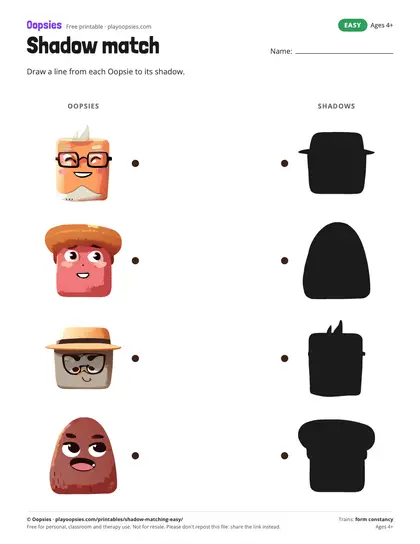 Shadow match Match 4 Oopsies to their shadows. Very distinct shapes.
Download PDF (124 KB)
Shadow match Match 4 Oopsies to their shadows. Very distinct shapes.
Download PDF (124 KB) 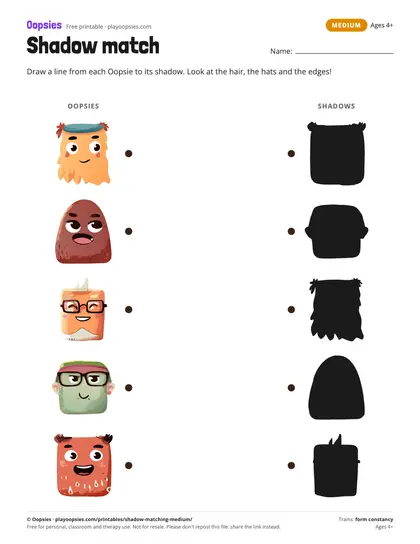 Shadow match 5 Oopsies, 5 shadows, with closer-looking outlines.
Download PDF (138 KB)
Shadow match 5 Oopsies, 5 shadows, with closer-looking outlines.
Download PDF (138 KB) 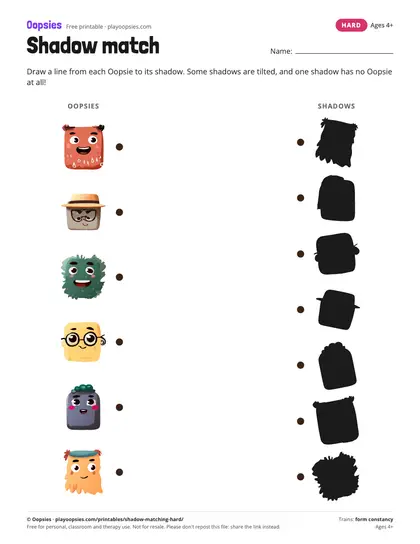 Shadow match 6 Oopsies, 7 tilted shadows, one with no Oopsie.
Download PDF (149 KB)
Shadow match 6 Oopsies, 7 tilted shadows, one with no Oopsie.
Download PDF (149 KB) 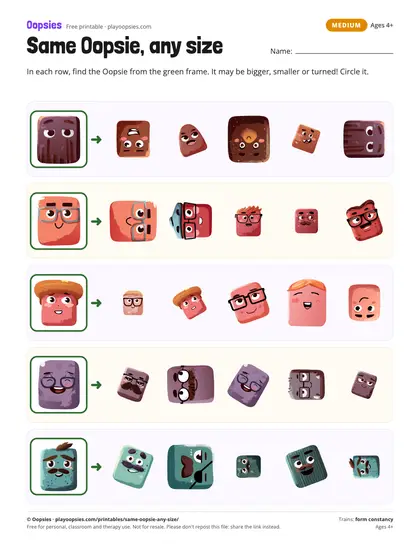 Same Oopsie, any size Find the framed Oopsie, bigger, smaller or turned.
Download PDF (224 KB)
Same Oopsie, any size Find the framed Oopsie, bigger, smaller or turned.
Download PDF (224 KB) Oopsies worlds that use form constancy
Oopsies is a seek-and-find game, and each world adds a twist. These are the ones where form constancy does most of the work:

🌑 Shadow Show
The Oopsie to find is shown as a shadow, so children match its outline without colors or face details. In some levels it is the other way round: the whole scene is shadows and the Oopsie to find is in color.
More about the Shadow Show world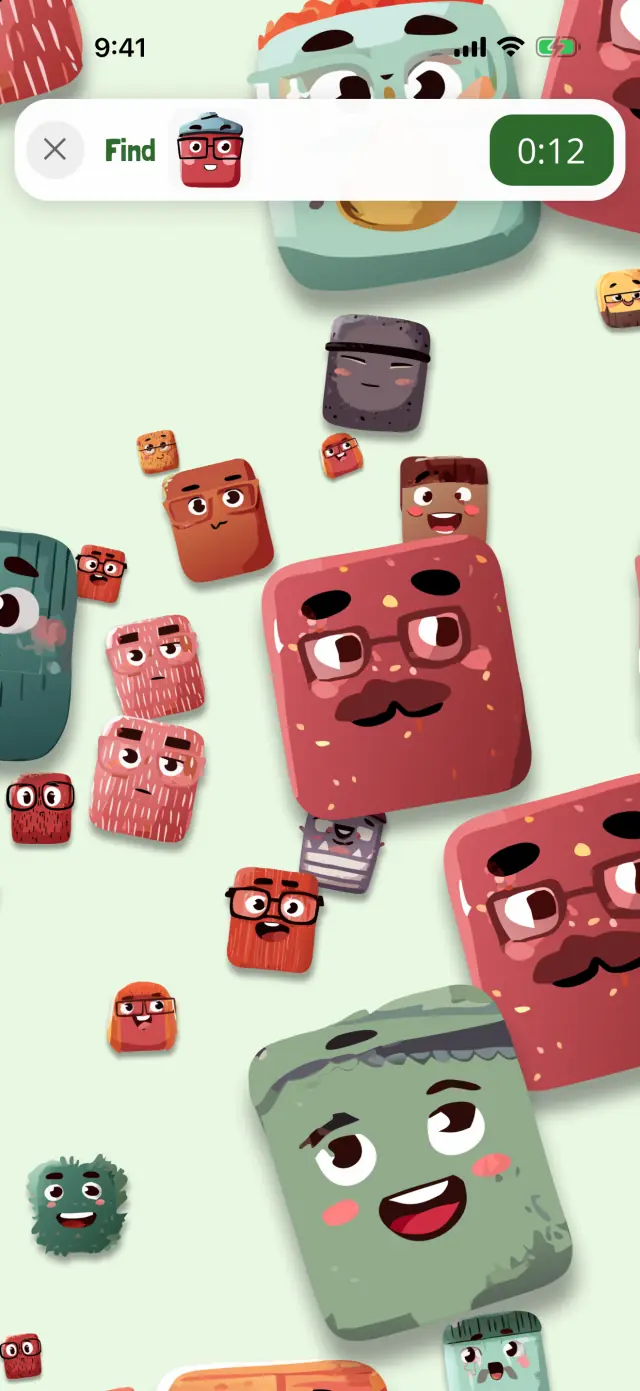
🐘 Tiny Titans
The Oopsie to find can be teeny-tiny, huge, or half hidden under a giant. Recognizing it whatever its size is form constancy at work.
More about the Tiny Titans worldRelated visual skills
Questions about form constancy
What is form constancy in simple words?
Knowing a shape stays the same shape when it gets bigger, smaller, turned or a different color.
What is the difference between form constancy and visual discrimination?
Visual discrimination is seeing that two similar things are different. Form constancy is seeing that two different-looking things are the same: the same letter in two fonts, the same Oopsie at two sizes.
Are shadow matching worksheets good for form constancy?
Yes: a shadow keeps the outline and drops colors and details, so matching it means recognizing the shape itself.
Last updated: October 16, 2026