Visual closure activities, with free PDF worksheets
Recognizing something from just a part of it. Knowing it's the cat when only its tail sticks out.
What is visual closure?
Visual closure is the ability to recognize something when you only see part of it. The brain fills in what is missing: you know the cat is under the sofa when only its tail sticks out, and you can read a word even when a coffee stain hides half a letter.
Why it matters
Reading uses it constantly: fluent readers recognize words without looking hard at every letter, and they recognize letters in unusual fonts or messy handwriting.
It also helps with jigsaw puzzles, dot-to-dot pictures, finishing a drawing, and recognizing things that are partly hidden, in a picture or in real life.
Signs a child finds visual closure hard
- Needs to see the whole picture before recognizing it
- Finds jigsaw puzzles or dot-to-dot pictures hard for their age
- Has trouble reading words in an unfamiliar font or handwriting
- Leaves gaps when drawing or copying shapes and letters
- Is puzzled by partly hidden objects in pictures
These are everyday observations, not a checklist and not a diagnosis: every child develops at their own pace, and many children show a few of these now and then. If something worries you, talk to your child's teacher or doctor. Eyesight is checked by an eye doctor; visual perception can be assessed by an occupational therapist.
6 visual closure activities for home and the classroom
-
Slow reveal At home or in class
Cover a picture with a sheet of paper and slide it away slowly. Your child guesses what it is as early as they can. Use familiar things first: an animal, a car, a face.
-
What's under the blanket? At home
Hide a toy under a blanket with one part sticking out (a wheel, an ear, a foot) and ask what it is. Show less and less of it.
-
Finish the drawing At home or in class
Draw half of a simple shape or face and let your child complete it. Then swap: they draw half, you finish it.
-
Dot-to-dot and dashed letters At home or in class
Simple dot-to-dot pictures and letters made of dashes ask the brain to see the whole shape before it is drawn.
-
Mystery letters In class
Write big letters and cover the top half (or the bottom half) with a strip of paper. Which letter is it? Then try short words.
-
Printable Who's peeking? At home or in class
The free sheets below show round close-ups of Oopsies to match with the whole Oopsie. The hard one zooms in on eyes, mouths and hair, with every Oopsie the same color.
Free visual closure printables
Made with the Oopsies from our game: one page to print, the answer key on page 2. Free for home, classroom and therapy use.
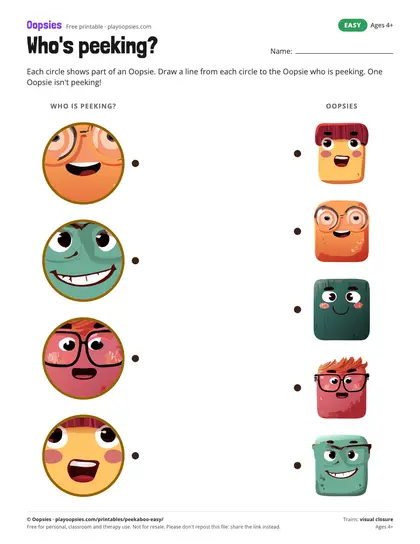 Who's peeking? Match 4 close-ups to the whole Oopsies. One extra Oopsie.
Download PDF (139 KB)
Who's peeking? Match 4 close-ups to the whole Oopsies. One extra Oopsie.
Download PDF (139 KB) 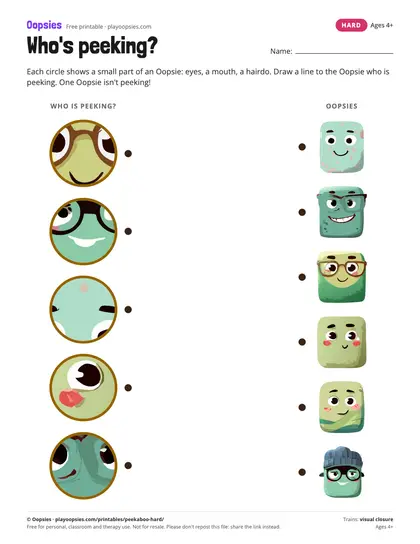 Who's peeking? Tight close-ups, all the same color. Eyes, mouths, hair.
Download PDF (155 KB)
Who's peeking? Tight close-ups, all the same color. Eyes, mouths, hair.
Download PDF (155 KB) Oopsies worlds that use visual closure
Oopsies is a seek-and-find game, and each world adds a twist. These are the ones where visual closure does most of the work:
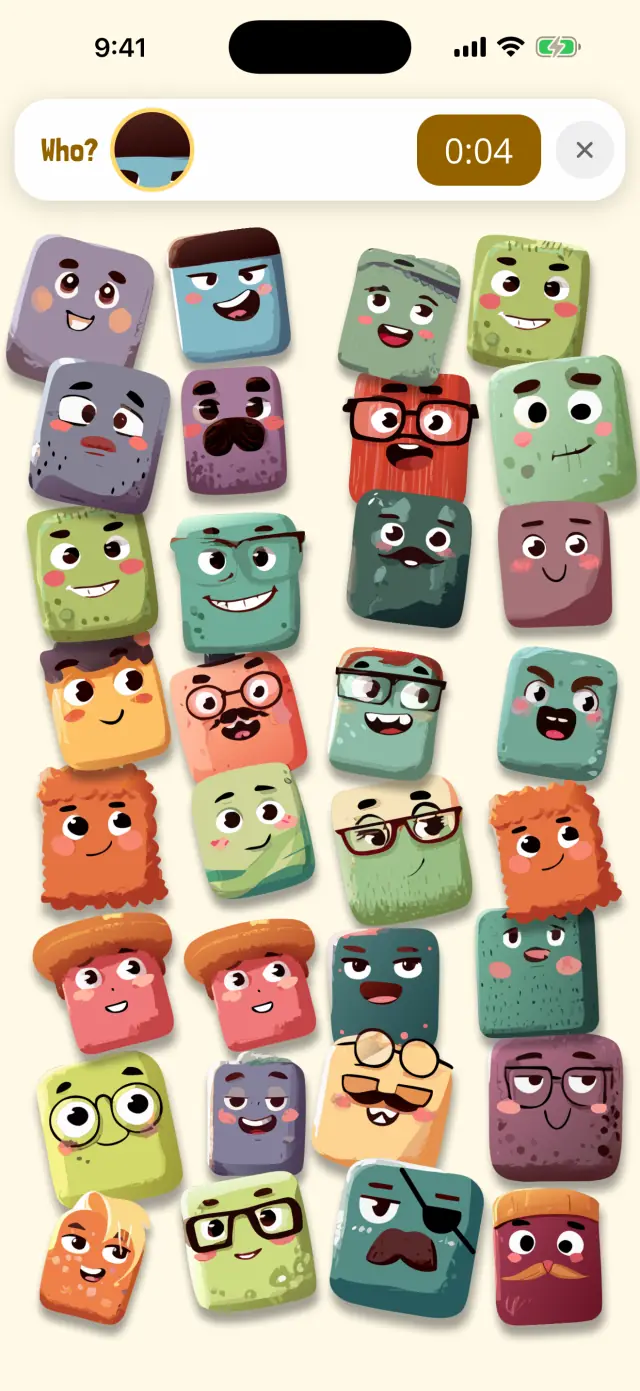
🔍 Peekaboo
You only see a close-up of the Oopsie to find (its face, its eyes, its mouth or the top of its head) and have to recognize it in the crowd. After a wrong tap, or 30 seconds without finding it, the close-up zooms out a little.
More about the Peekaboo world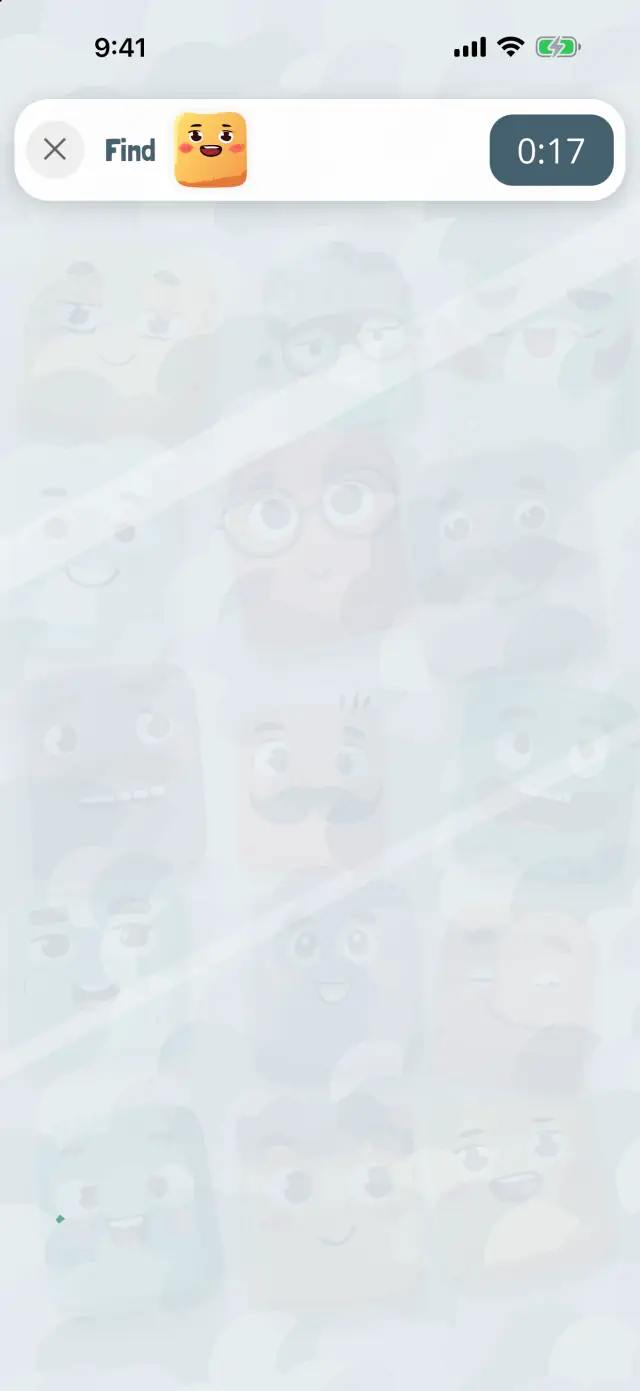
🪟 Foggy Window
The Oopsies are behind a misted window. You wipe a patch clear with your finger and the fog slowly comes back. Through the fog you can only guess blurry shapes, and later levels bring thicker fog that returns faster.
More about the Foggy Window worldRelated visual skills
Questions about visual closure
What is visual closure in simple words?
Seeing the whole from a part: recognizing a picture, a letter or an object when some of it is hidden or missing.
What is the difference between visual closure and figure-ground?
Figure-ground is finding a whole thing in a busy background. Visual closure is recognizing a thing when part of it is missing or covered. A partly hidden Oopsie in a pile uses both.
Are jigsaw puzzles good for visual closure?
Yes: guessing what a piece shows, and imagining where it fits in the whole picture, is visual closure practice. Start with few, large pieces.
Last updated: October 16, 2026