Visual scanning activities for kids, with free PDFs
Searching a space with the eyes, in order. Reading a line of text, or checking a shelf for the cereal.
What is visual scanning?
Visual scanning is the ability to search a space with the eyes in an organized way: left to right, top to bottom, without skipping parts or checking the same spot over and over.
Why it matters
It's how we read a line of text, check a list, find a name on a class list, or look both ways before crossing the street. Organized scanning makes finding things faster and less tiring.
Children who scan at random often know what they are looking for perfectly well; they simply miss it because their eyes never land on it.
Signs a child finds visual scanning hard
- Searches at random, looking at the same places again and again
- Often misses things on one side of the page or the table
- Skips words, lines or questions on worksheets
- Takes a long time to find something that is in plain sight
- Gets tired or frustrated quickly with search games
These are everyday observations, not a checklist and not a diagnosis: every child develops at their own pace, and many children show a few of these now and then. If something worries you, talk to your child's teacher or doctor. Eyesight is checked by an eye doctor; visual perception can be assessed by an occupational therapist.
6 visual scanning activities for home and the classroom
-
Left-to-right letter hunt At home or in class
On a page of big letters, circle every A, moving a finger along each line from left to right, like reading. The finger teaches the eyes the route.
-
Shopping list spotter At home
Give your child a picture list at the supermarket and let them spot each item on the shelves, top to bottom.
-
Flashlight search At home
Stick a few stickers on a wall in a dark room. Your child sweeps a flashlight across the wall, row by row, to find them all.
-
Count the red cars At home or in class
Count every red car in a busy picture, or on the street from a window. Counting all of something forces the eyes to cover the whole scene.
-
Simple word search In class
Big letters, short words, and only left-to-right words at first. Add vertical words once that is easy.
-
Printable seek and find and I spy At home or in class
The free sheets below go from an easy crowd of different Oopsies to counting every Oopsie of a color or with glasses. Answer keys are on page 2.
Free visual scanning printables
Made with the Oopsies from our game: one page to print, the answer key on page 2. Free for home, classroom and therapy use.
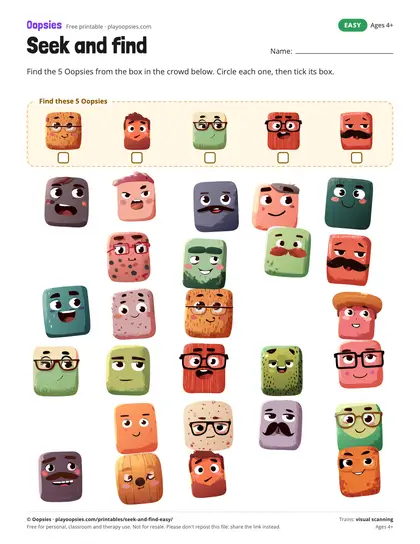 Seek and find Spot 5 Oopsies in a crowd of 26. Big drawings, no lookalikes.
Download PDF (273 KB)
Seek and find Spot 5 Oopsies in a crowd of 26. Big drawings, no lookalikes.
Download PDF (273 KB) 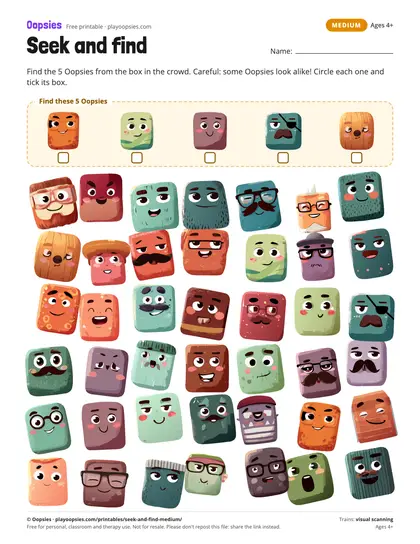 Seek and find 5 Oopsies hidden among 42, with some same-color lookalikes.
Download PDF (343 KB)
Seek and find 5 Oopsies hidden among 42, with some same-color lookalikes.
Download PDF (343 KB) 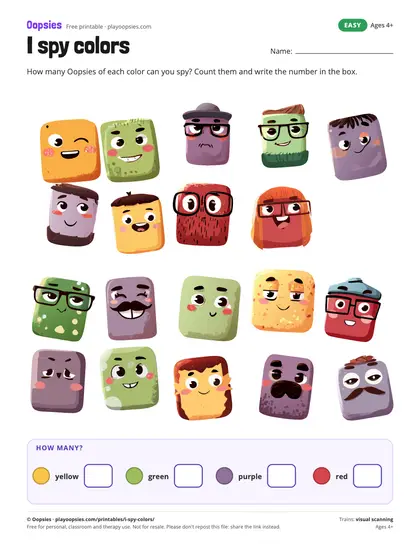 I spy colors Count the yellow, green, purple and red Oopsies.
Download PDF (221 KB)
I spy colors Count the yellow, green, purple and red Oopsies.
Download PDF (221 KB) 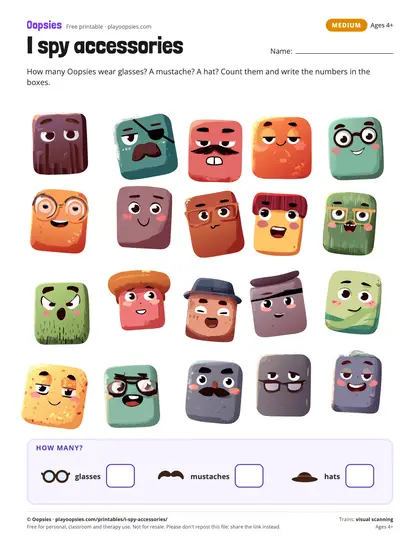 I spy accessories Count glasses, mustaches and hats. Picture labels, no reading.
Download PDF (216 KB)
I spy accessories Count glasses, mustaches and hats. Picture labels, no reading.
Download PDF (216 KB) Oopsies worlds that use visual scanning
Oopsies is a seek-and-find game, and each world adds a twist. These are the ones where visual scanning does most of the work:
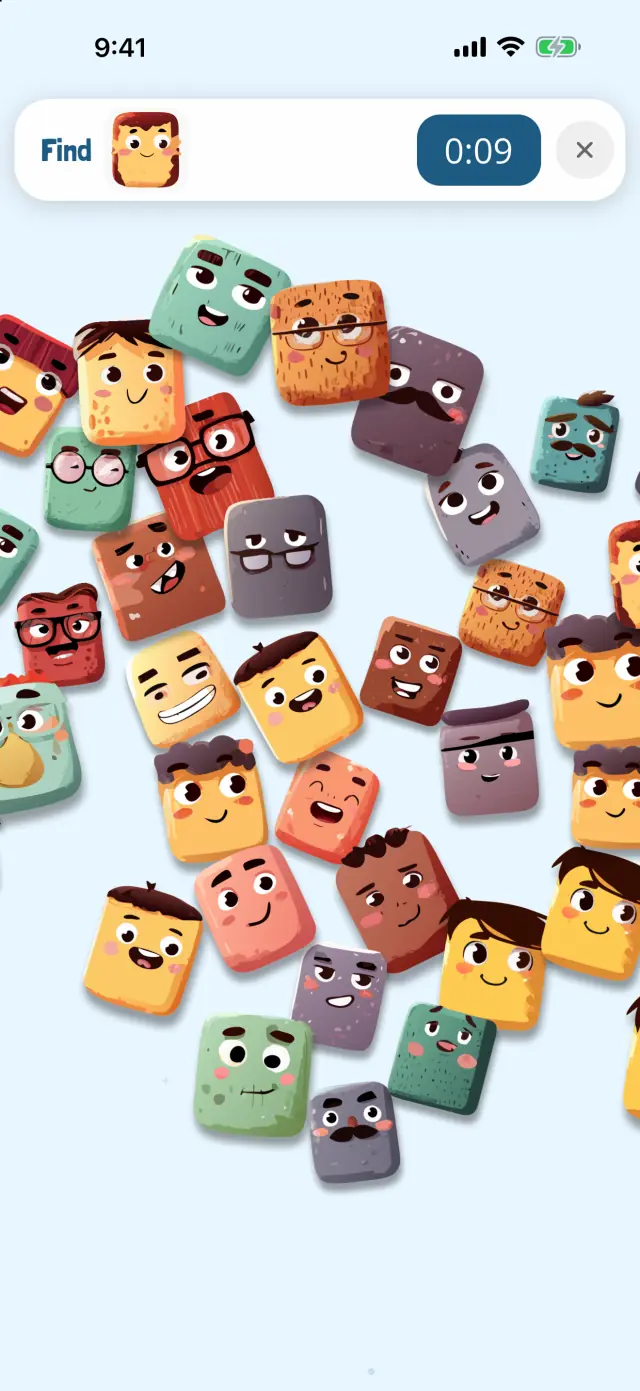
🥰 Frosti Floops
The Oopsies fill the whole screen, packed tight. Finding the one shown means sweeping the crowd without skipping a corner.
More about the Frosti Floops world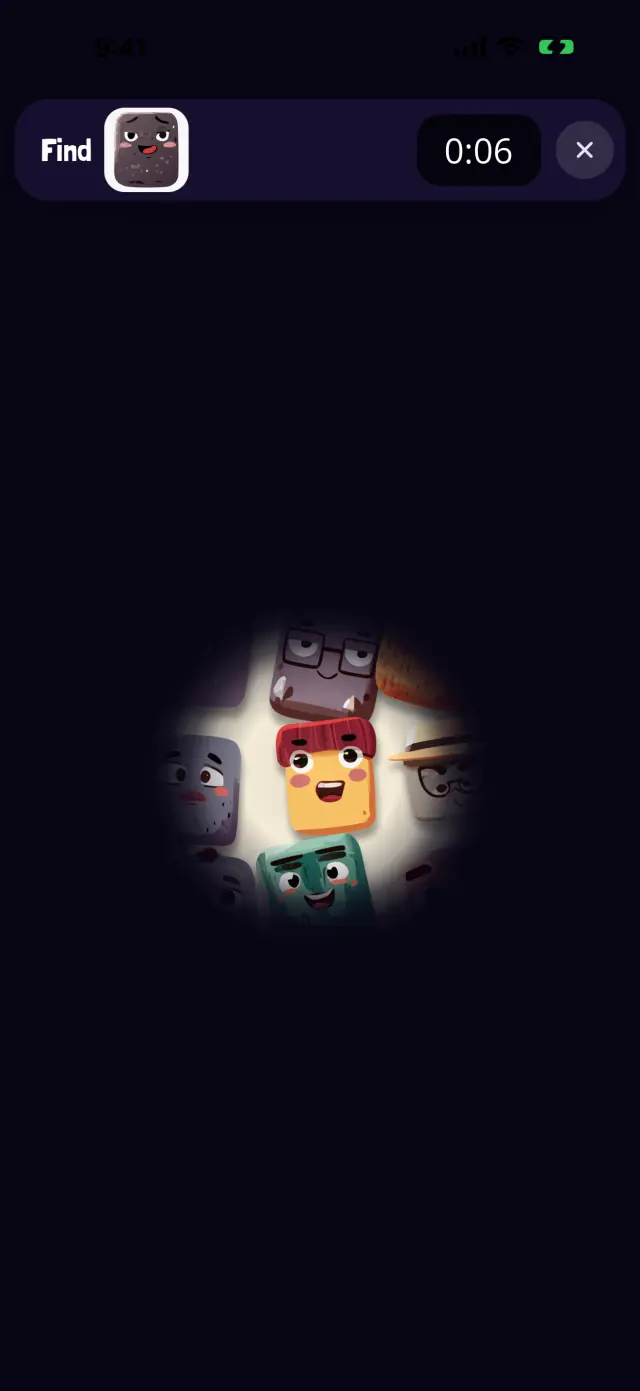
🔦 Lights Out
The screen is dark, and the flashlight only lights three or four Oopsies at a time. Children move it around to search, so an organized sweep pays off. Later levels shrink the light and make it flicker.
More about the Lights Out worldRelated visual skills
Questions about visual scanning
What is the difference between visual scanning and visual tracking?
Scanning is searching a still scene with the eyes, in order. Tracking is following something with the eyes: a moving ball, or a line of text. Reading uses both.
How can I help my child scan in an organized way?
Give their eyes a route: left to right and top to bottom, like reading, with a finger or a ruler under each row at first. Counting games help too, because you have to look everywhere to count everything.
Are seek and find games good for visual scanning?
Yes. They are scanning practice by design, especially when the child is encouraged to search in order rather than at random.
Last updated: October 16, 2026