Visual discrimination activities and free worksheets
Seeing what makes two similar things different. Telling b from d, or finding your own coat on a full peg.
What is visual discrimination?
Visual discrimination is the ability to notice how things you see are alike and how they differ: their shape, color, size and small details. It is what tells a child that b and d are two different letters, or which of two almost identical pictures has an extra button.
It is not the same as eyesight. A child can see perfectly well and still find it hard to compare two similar shapes, because visual discrimination is about how the brain sorts out what the eyes see.
Why it matters
Reading leans on it from day one: many letters only differ by one small detail (b and d, n and h, m and w), and so do numbers (6 and 9) and math signs (+ and ×).
It helps outside school too: spotting your own water bottle among the class bottles, matching socks, noticing that a puzzle piece is the wrong way round, or seeing that a friend has a new haircut.
Signs a child finds visual discrimination hard
- Keeps mixing up letters or numbers that look alike, after classmates have mostly stopped
- Finds "spot the difference" and matching games frustrating rather than fun
- Doesn't notice small changes, like a missing piece or a new picture on the wall
- Sorts objects by one feature only (color, say) and misses the others
- Copies words or shapes with details missing or added
These are everyday observations, not a checklist and not a diagnosis: every child develops at their own pace, and many children show a few of these now and then. If something worries you, talk to your child's teacher or doctor. Eyesight is checked by an eye doctor; visual perception can be assessed by an occupational therapist.
6 visual discrimination activities for home and the classroom
-
Sock pairs At home
Tip a basket of clean socks on the floor and ask your child to find the pairs. Start with very different socks, then add pairs that only differ by a stripe or a heel color.
-
Real-life odd one out At home or in class
Line up four spoons and one fork and ask which one doesn't belong. Then make it subtler: four red blocks and one orange, four big buttons and one with only two holes.
-
Spot the difference, homemade At home or in class
Draw two simple faces side by side, the same except for one detail (a freckle, an eyebrow, a missing ear). Let your child find it, then swap roles and let them draw the pair for you.
-
Letter hunt In class
Give a short text in big print and ask children to circle every b, and only the b's (not the d's). Next time, hunt for the p's among the q's.
-
Button sorting At home or in class
Sort a pile of buttons by color, then by size, then by number of holes. Each round makes children look at a different detail of the same objects.
-
Printable odd one out and twins At home or in class
The free sheets below start with differences in color and end with one missing accessory among Oopsies of the same color. Answer keys are on page 2.
Free visual discrimination printables
Made with the Oopsies from our game: one page to print, the answer key on page 2. Free for home, classroom and therapy use.
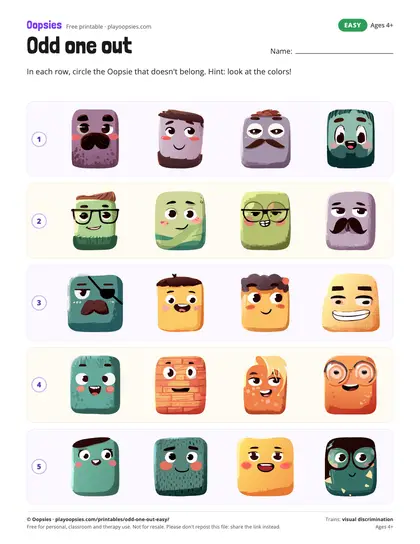 Odd one out 5 rows: all the same color except one.
Download PDF (224 KB)
Odd one out 5 rows: all the same color except one.
Download PDF (224 KB) 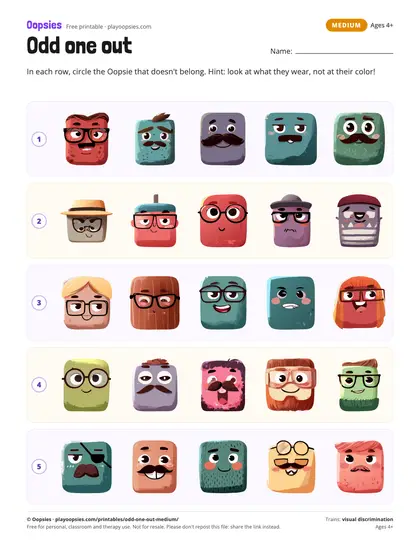 Odd one out Rows share an accessory. Colors are mixed, so they don't help.
Download PDF (260 KB)
Odd one out Rows share an accessory. Colors are mixed, so they don't help.
Download PDF (260 KB) 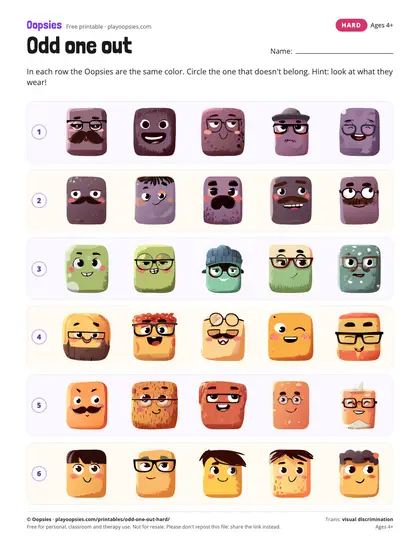 Odd one out Same color in every row. The odd one only lacks the accessory.
Download PDF (308 KB)
Odd one out Same color in every row. The odd one only lacks the accessory.
Download PDF (308 KB) 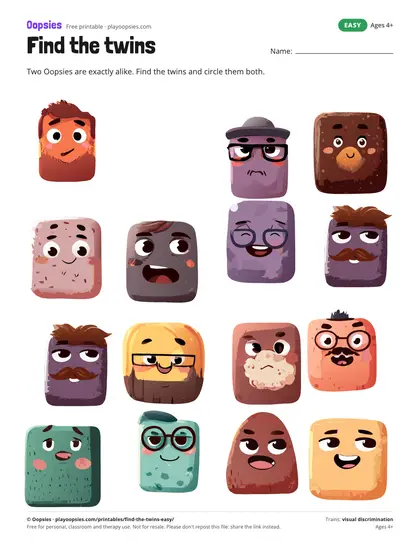 Find the twins 15 Oopsies, one pair of identical twins.
Download PDF (160 KB)
Find the twins 15 Oopsies, one pair of identical twins.
Download PDF (160 KB) 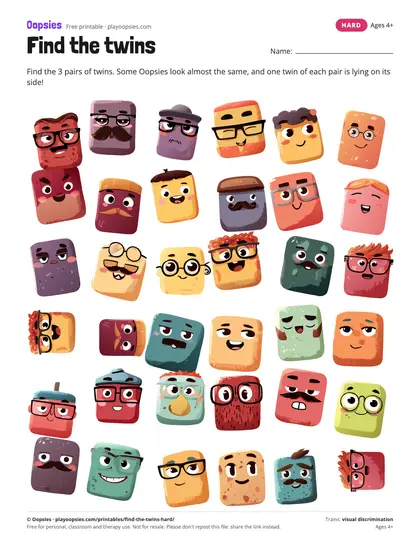 Find the twins 3 pairs among 36, lookalike cousins, one twin of each pair turned.
Download PDF (262 KB)
Find the twins 3 pairs among 36, lookalike cousins, one twin of each pair turned.
Download PDF (262 KB) Oopsies worlds that use visual discrimination
Oopsies is a seek-and-find game, and each world adds a twist. These are the ones where visual discrimination does most of the work:
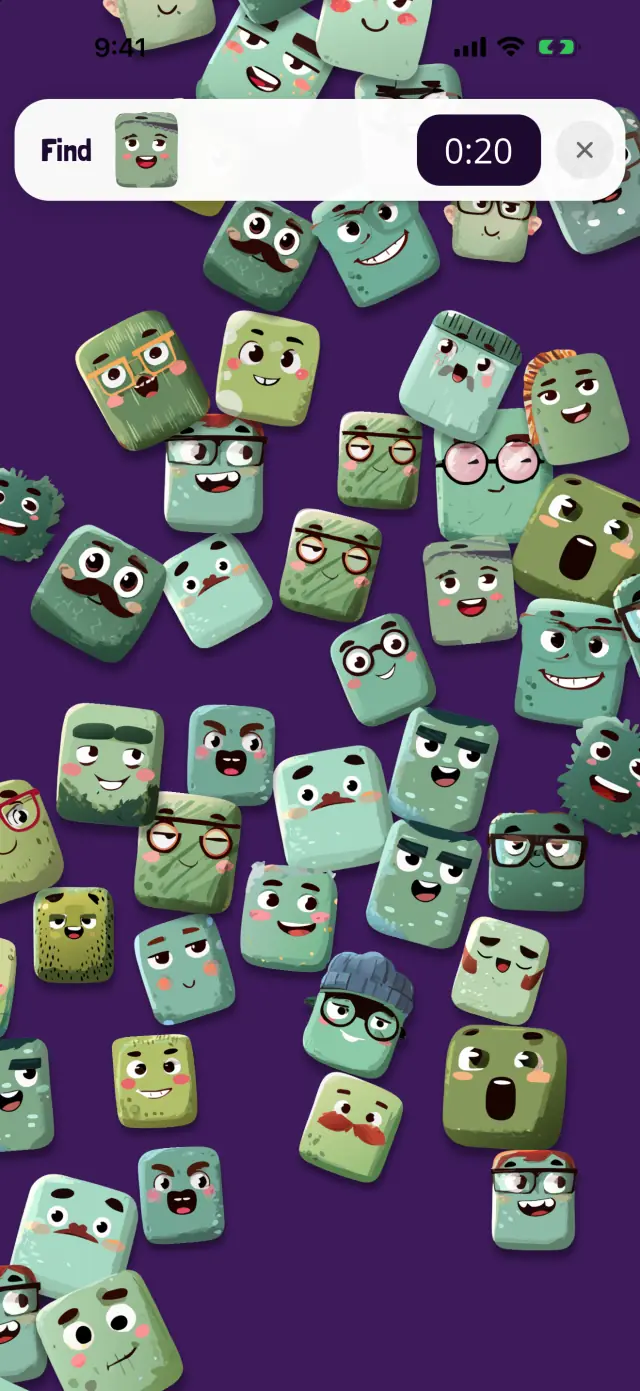
💡 Odd Ones
Every Oopsie on screen shares a feature with the one to find: its color, an accessory, its smile or its shape (all red, all with a mustache, all with glasses…). That shared feature never gives it away, so children compare faces and small details.
More about the Odd Ones world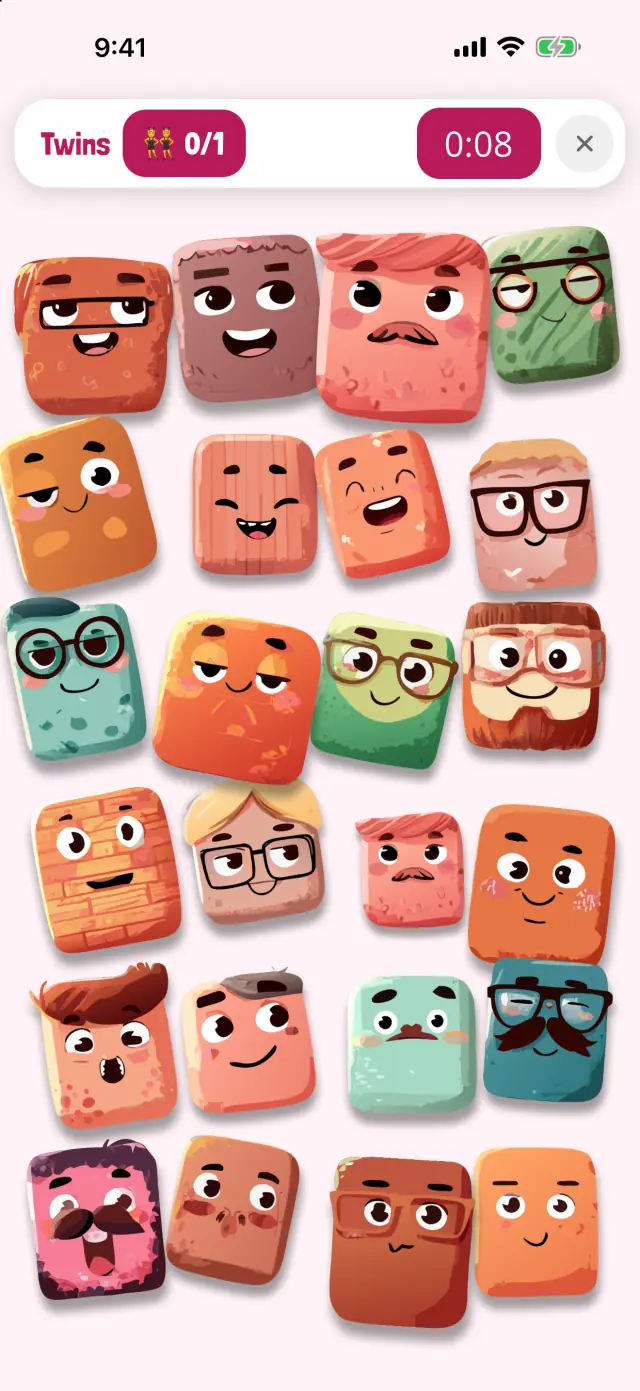
👯 Double Trouble
No Oopsie is shown to look for: two of them are exactly alike, and you find the pair. Later levels add "cousins" with the same color and accessory, twins of different sizes, and twins turned another way.
More about the Double Trouble worldRelated visual skills
Questions about visual discrimination
What is visual discrimination in simple words?
It is seeing the difference between things that look alike: two letters, two shapes, two pictures. A child who spots that two Oopsies have the same color but only one wears glasses is using visual discrimination.
Is visual discrimination the same as good eyesight?
No. Eyesight is how clearly the eyes see; visual discrimination is how the brain compares what the eyes see. An eye test checks eyesight, not visual perception.
What are good visual discrimination activities for preschoolers?
Matching and sorting games with real objects (socks, buttons, blocks), simple odd one out rows, and "what's different?" pictures. Start with big differences, like color, and move to small details once that is easy.
Last updated: October 16, 2026